

Welcome to Mind Mastery
Football is one of the most powerful learning vehicles we use within Mind Mastery because it naturally engages the body, emotions and attention systems before requiring verbal processing. For many children with SEND or early adversity, traditional classroom-based learning places demands on language, impulse control and executive function that their nervous systems are not yet ready to meet. Football reverses this process by meeting children where they already feel competent, motivated and safe.
From a neurodevelopmental perspective, physical movement activates the sensory and motor systems, helping regulate the autonomic nervous system (Porges, 2011). Once the body is regulated, the prefrontal cortex—the area responsible for thinking, reflection and emotional control—becomes more accessible. This is why football creates a “window of readiness” for learning that many children cannot access through talk alone.
We deliberately anchor Mind Mastery practices to elite football role models because children learn best through modelling, not instruction (Bandura, 1977). When children see players they admire using regulation tools, the practices feel meaningful rather than imposed.
Examples include:

We use footage of Ronaldo pausing, breathing and grounding before free kicks to teach controlled breathing. This mirrors clinical breath regulation strategies used to reduce arousal and impulsivity, making them relatable and aspirational.

Salah’s calm, centred responses are used to introduce bilateral stimulation through the Butterfly Hug, a trauma-informed regulation tool that supports emotional containment and nervous system balance.

Haaland’s calm, focused pre-game routines help children understand stillness, visual focus and mental rehearsal—key elements of emotional regulation and performance psychology.
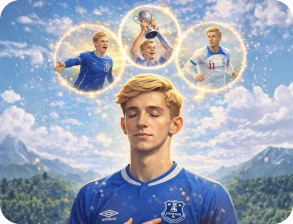
Gordon’s preparation and recovery routines are used to teach visualisation, helping children mentally rehearse success and develop confidence and belief.
Football also allows us to teach emotional literacy in real time. Success, failure, frustration, excitement and disappointment all occur naturally during play, giving authentic opportunities to practice regulation, reflection and reset strategies in the moment, something especially important for children with early adversity who struggle with delayed or abstract learning.
For younger children, football offers structure, predictability and repetition, which are critical for emotional safety and habit formation. For SEND learners, it provides immediate feedback, clear goals and embodied success, supporting motivation and self-belief.
In Mind Mastery, football is not the reward it is the classroom. Through movement, modelling and meaningful engagement, we embed clinical practices into experiences children understand, enjoy and remember, ensuring learning transfers beyond the session and into everyday life.
Real stories from students, parents, and educators we support
We have been so fortunate to have the opportunity to work with Mark (Mr D) and his team and the impact on our children has been evident from the very first sessions they participated in, it's amazing to see them continue to make such rapid progress throughout this journey of self - discovery.
The focus of the programme ensures children are supported to develop a lifelong positive mindset by forming daily self-management habits and routines, whilst reducing limiting beliefs and boosting self confidence.
A crucial part of the work is staff training which is integral to the initial programme delivery ensuring staff are upsillked and able to continue this positive support once the input from Mr D or one of the Mindset Coaches has completed.
Poems
Before minds can listen, bodies must feel,
Calm in the moment, grounded and real.
So, we start with the boots, the ball and the run,
Because movement first opens the door to the fun.
When nervous systems settle, the thinking can grow,
That’s neuroscience speaking, what Mind Mastery know.
From Porges to Siegel, the research is clear,
Regulate the body, for learning to appear.
We teach through the heroes they already know,
The players they watch, through legends they grow.
Not lectures or telling, but modelling true,
“If Ronaldo does it… I can do it too.”
Cristiano breathes deep; before striking the ball,
So, we pause, breathe, reset; controlled stop for all.
Mo Salah stays calm, arms crossed, holding tight,
Butterfly hugs help emotions feel right.
Haaland sits still, calm before the storm,
Meditation shows focus can be the norm.
Anthony Gordon sees goals before they arrive,
Visualisation helps belief come alive.
On the pitch, emotions don’t hide away,
They show up in tackles, in goals, in the play.
Frustration, excitement, mistakes and success,
Perfect moments to practise; pause, breathe and assess.
For SEND learners, football speaks loud and clear,
Clear rules, quick feedback, success feeling near,
For children with adversity, trust grows fast,
Because the game lives in the now ; not in he past.
Football’s not the reward, not the prize at the end,
It is the classroom, the lesson, a pupil’s best friend.
Each drill builds confidence, each reset builds skill,
Each moment says “You can — and you will.”
So, when boots hit the ground and the learning begins,
We’re shaping regulation, belief from within.
Through movement and mastery, hope starts to bloom,
Because when the mind learns to play;
the future finds room!